Wednesday, September 19, 2012

June 11 - wind, camp life


Tent compound, the bottom right tent was my home for 5 weeks

I lay here writing, amid the yellow light cast by the 10pm sun shining through the walls of my tent. Outside the confines of my personal dome of calm, the wind rages onward. For over two days now the sustained winds haven’t dropped below 20mph – with peak gusts of 42mph. The flapping noises from the guttering tent fly are a constant and unpredictable background noise to anything camp-related.
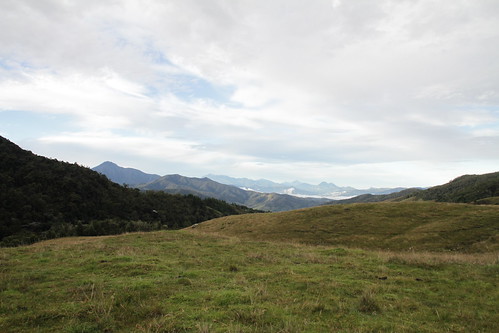
In camp we have 2 mini-compounds, both surrounded by electrified high-voltage bear fencing. Our personal one-man tents are in one of the cordoned off areas, and the two large tends that house the cooking/dining facilities and the data storage/equipment make up the other. The camp is set on a small ridge about 30 feet above a backwater of the Canning River, with a 360° view of the Arctic tundra. The formidable mountains of the Brooks Range act as a backdrop to the south, while at the same time you can look north and see icebergs in the Arctic Ocean looming up over the horizon.

View from outside the cook tent looking south towards the mountains, taken around ~9pm


View from the edge of the bluff, looking northwest over the sleeping tents at ~10pm

Primarily we are only in camp from about 6pm-9am, from when we return for dinner and data entry until we depart in the morning after breakfast for another day of fieldwork. I personally pretty much only visit my tent for sleeping and never visit it otherwise – not even for a nap as of yet!
An average day at camp starts off with waking up at some point in the morning, wondering what time it is, since the sun doesn’t help you with that, and then trying to motivate yourself to get out of your wonderfully warm down sleeping bag and put on cold clothes and waders. I never set a personal alarm, instead using the bear fence as my alarm! The fence makes a periodic ticking noise when it is on, every 5 seconds or so, as a warning to anyone who might be nearby. In order to leave the sleeping tents to head to the cook tent you have to turn the fence off, so I know that if it is off then someone else is already up! Unfortunately sometimes this gets me up a bit later than most people, but I’ve only been last a couple times!


Lapland Longspur, the single most abundant bird in the study area

We then eat breakfast, get assigned to what part of the study area we are going to, and who with, make our lunch/snack baggies, and head out! Usually about 8-10 hours later we get back to camp, ready to sit down and eat some warm food! Then it is time to swap stories from the day, unwind, and then do the after dinner bird list, where everyone compiles their sightings from the day onto one master list. The bird list is done every night, and is a completing ritual, once it is over people usually start drifting toward their sleeping bags. The last couple people up input some data from the past day, arrange tasks for the following morning, and then close up camp before commuting the 30 meters back home to camp.

Pectoral Sandpiper male, distinguished from the female by the black mottling on the chest. This is one of our five study species.


Tuesday, September 18, 2012

First week (June 4 - June 10)


 Mark checking the guns before we headed out for the day.

For the first week or so that we were there, the days mostly ran together. The amount of snow and ice present was more than usual, which was causing the start of the nesting season to be delayed slightly – leaving us with not too much work at the start. The average day would get us in only in mid-afternoon, giving us the afternoons to do what we wanted.

Male Rock Ptarmigan, not so camouflaged without the snow

Female Rock Ptarmigan - amazingly well camouflaged, and strikingly different from the winter plumage.

One of the first few days Alfredo and I struck out for the Arctic Ocean, a 3 mile one-way trip, and totally worth it. A very cool walk, it went by an old abandoned graveyard that was a remnant from a settlement here back in the mid 20th century. Once we reached the ocean and the beaches there, we did the token walking out onto the pack ice, looked around for a bit, and then headed back. Even in early June the ice was still all the way up to the coast, and is usually like that through most of the summer. This is one of the locations in the world where global warming and climate change is most noticeable – since the timing of the melting of ice has significantly changed, and the amount that melts annually has greatly increased as well.

The Arctic Ocean! Nothing between me and the North Pole except ice and water.

The old graveyard, complete with caribou skull

This early part of the season was interesting bird-wise, since many of the birds had not yet staked out their territories, since much of it was all still under snow. As a result, the small muddy/wet grassy areas that were open served as a great attractant for everything, and were a great spot to resight birds banded in previous years.

It was also great for photography, with such stars as these Stilt Sandpipers

At this time of the season we also had many Pomarine Jaegers flying past, the most range-restricted breeder of the three jaeger species. Pomarines cruise along the coast in small groups in early summer, looking for an abundance of lemmings in an area, where once found, they will nest. Due to this nomadic lifestyle, their year-to-year nesting areas are unpredictable and wide ranging. We had no birds nesting near us, but in this early period we had upwards of 60 (!) Pomarine Jaegers in a day, all cruising along the coast heading east, looking for some lemmings.

Here is one of the Pomarine Jaegers cruising eastward - searching for food and family

The most widespread jaeger, the Parasitic Jaeger, was seen daily in numbers of at least 5+.

During this period many of the birds were starting to nest, and we found our first shorebird nests, along with some Sabine’s and Glaucous Gull nests and quite a few Lapland Longspur nests.

Sabine's Gull long-calling near a nest.

Lapland Longspur nest - a very commonly stumbled upon nest in the field

Glaucous Gull liberating a Cackling Goose egg from the nest

From here I am going to skip to 11 June, when I started keeping a nightly journal in camp, a much more accurate and detail-oriented read of the day-to-day events!

Monday, September 17, 2012

Arrival at camp


 The view at Kavik around midnight

After a night of camping at Kavik we woke up and awaited the weather report to see if the fog had cleared at the Canning. A couple hours passed before we finally had enough visibility to head out, but once we got the go-ahead – we were soon on our way.
A relatively quick ~30 mile flight later, and we were there. We dropped down through a hole in the fogbank and flew under the low cloud layer, a few hundred feet off the ground. Among the stark white landscape the pilot picked out our landing location – a frozen lake about a kilometer from our soon-to-be camp.
Upon landing we were struck by the desolation of the location for early June – with the entire land being enshrouded with snow and ice as far as the eye could see, with only small mounds of brown earth poking up here and there - an amazing contrast from the Kavik landscape only 30 miles away.

The view when we landed. Camp can be seen on the right side of the photo.

The rest of the day was filled with transporting all of our gear from the landing site to camp, and setting up the weather station and tents. Like most of the days there in the first couple weeks, it was windy, cold, overcast, and usually foggy. Quite a scene for June!

Setting up the weather station. The bathroom is on the left, the cook and mess tents are on the right.

Alan walking from the mess/book tent compound to the sleeping tents. The yellow wire in the front is our bear fence, a solar-powered electric deterrent.

It was probably the most challenging walking in these first couple days, due to the slush and snow most places, but it made it so much easier to carry things in sleds. The blue sled pictured above was what we used to transport all of our food, propane, guns, personal gear, and every piece of equipment, all dragged a kilometer (0.6 miles). Every single thing that we brought in had to be brought out, even solid waste!

Saturday, September 15, 2012

Heading north


The previous day everyone that I knew had left in trucks, driving north beyond technology. I spent the day in my hotel room, venturing out for some birding in town, and the rest of the time editing some last photos and using some last internet while I still could.
This morning I had arranged with the two people still here, Elin and Alfredo, to come pick me up. I had never met either of them before, but come 8am they picked me up, we were off to the airport, and soon after headed north.
We flew in little Cessna prop planes, with our “fleet” consisting of a Cessna 185, a smaller aircraft, and a Cessna 207, which held more cargo more easily. They were both small 2-3 seaters, wonderful to fly in. It is so much more exciting flying in small planes as compared to jet liners. You actually feel the air currents you’re in, and the aircraft is responsive and overall more enjoyable in my opinion.
One of our planes, the Cessna 207, complete with snow skis

Our flight lasted a couple hours until we landed at Kavik to refuel. As it turned out, the Canning was fogged in by the time we got there, as is typical, so we ended up spending the night at Kavik, camping on the gravel at the edge of the river there.
Kavik is a very cool place, a runway right by a river just north of the mountains, and a few Quonset huts and old container boxes arranged in rows for housing and protection from the elements. It is a destination for wildlife film crews, people who just want to get away, or anyone for that matter who wants to spend the $270/night to stay in one of the containers. Talk about the only game in town!

View of Kavik looking south

It is also used as a place to refuel, which is what why we were there. Despite the remoteness, Kavik has internet, satellite television, a whole wall of refrigerators, and even some fresh baked chocolate chip cookies when we arrived - pretty unexpected for the middle of nowhere.

Alfredo enjoying our last movie for a long time

After dinner we took a walk down an old ATV track that is a remnant from oil exploration in the mid-20th century, a few miles each way. It was simply beautiful, with a backdrop of mountains right next to us to the south, and rolling hills all around. We saw a couple small herds of caribou, and lots of cool birds that we wouldn’t see at the Canning – the highlights of which were Bluethroat and Smith’s Longspur. This area still actually had shrubs that were in some places taller than head-height, which would be a completely foreign concept in just a couple days!

Red Foxes den under one of the Quonset huts

One of the Bluethroats singing, sometime around midnight

Fairbanks prelude


Fairbanks airport and surrounding city from the air.

Our journey started off in the center of the state, in the city of Fairbanks. We flew up there on the 29th of May, having a couple days of prep and groundwork to do before we headed out into the middle of nowhere. The crew included five members from the Manomet Center for Conservation Sciences, a non-profit organization that I have worked for doing songbird banding for many years, and also happens to be the place/experience that got me interested in birds initially. The five Manomet people were me, Brad Winn, Alan Kneidel, Laura Koloski, and Mark LaFaver. Unfortunately I never got a group photo of everyone at any point throughout the trip!
The rest of the crew was made up of employees of the US Fish & Wildlife Service, with Scott Freeman being the crew leader, and Elin Pierce and Alfredo Soto rounding out our eight-person crew. The whole project is a joint effort between Manomet and the USF&WS, with funding provided by grants from both sides. The project is part of a larger network of research sites, the Arctic Demographic Shorebird Network.
On June 1 five of the crewmembers headed north in trucks, driving all day from Fairbanks to a remote airstrip at Galbraith Lake, north along the Dalton Highway, and just south of the Brooks Range. The following day they started flying into camp, leaving in bush planes from Galbraith and flying over the mountains to the coastal plain, where they landed on a frozen lake, as we all would, where they begun to set up camp.
The three remaining people, one of which was me, stayed one more night in Fairbanks, and then flew from Fairbanks to the Canning directly, with a stop at Kavik Airstrip, another tiny airstrip in the middle of nowhere, this one on the north side of the Brooks Range.

Boreal Chickadee nesting right outside our hotel in Fairbanks

Summer in Alaska

My summer was spent at the green arrow location (Picture: Google Maps)

Once again it has been over a year since I have done anything blog-related. However, since I have more travel experiences to write about -  so I'm back for a while again!

This summer I worked in the Arctic National Wildlife Refuge on the North Slope of Alaska – working on the breeding ecology of five species of shorebird: Semipalmated Sandpiper, Pectoral Sandpiper, Red Phalarope, Red-necked Phalarope, and Dunlin. We spent the days searching for their nests, and then once found we monitored the nests until hatching, and also put bands on the adults incubating the nests that we find.
In addition to the nest searching and banding, we also resighted birds that have been previously banded, taking down the GPS coordinates for any birds that we see that already have bands. This is the third year of a 5 year study, with the goal of the study to determine survivorship in these birds, a goal that is achieved by seeing how many return to the breeding area that have been marked in previous years, showing us what percentage of birds make it back to this site annually.

An example of a banded bird, with a 3 letter alpha-code flag, four color bands, and a metal band with a 9-digit number on it.

We were at the Canning River Delta, our field site, for five weeks doing this work. I started keeping nightly journal entries after a week or so there, which I kept up until the end. I wish I had started at the beginning! I’ll try to post one daily, along with some photos taken that day. 

Saturday, July 30, 2011

Urrao, 6/20-21/11


After a couple days at the great Piha reserve, we had to head back to Medellín, and off to Urrao. We arrived in the north bus terminal in Medellín, and had to head out of the south terminal, a highly inferior terminal in the fact that it didn't have a Dunkin Donuts, our equivalent of the American embassy wherever we went. Today was a solid day of travel, from 6am at the Piha reserve until after dark when we arrived in Urrao. The drive was interesting in that it went through valley after valley that had been denuded of all vegetation to grow coffee. It was a rather shocking illustration of why you should buy shade-grown coffee, the difference in ecological impact is huge.

However, the most notable part of the drive was when we rounded a corner to see a ~50 foot stretch of road that was covered in mud, with more coming down from the bare slope above the road every moment. Rain came down the entire drive to Urrao, so this was something that had happened recently and was still happening. It was mildly unnerving looking upslope and seeing small stones rolling down, and also trickles of watery mud adding to the stuff already on the road. We made a go for it through the mud, but we couldn't get up enough speed to combat the slight upwards angle of the road, and had to retreat back to solid ground. After sitting there for about 40 minutes, the resourceful driver paid a construction worker to drive the tractor that was sitting on the side of the road, and he promptly bulldozed the mud out of the road, and we were on our way - it could have been much worse.

Long-tailed Sylph

Once at the town of Urrao, we went to the hotel we were planning to stay at, which turned out to be one of the best hotels I've ever stayed at in Latin America. The water pressure was so high that the drain had trouble keeping up, the water was hot, internet fast, beds soft, and they gave you free drinking water. What more could you ask for? Up early the next morning we hopped in a 4WD pickup to go to the starting point for our hike to the next spot: the Colibrí del Sol reserve, a place I'll just call it the Urrao reserve from here on out. The Urrao reserve is unique in that it hosts at least 4 species that are pretty much un-seeable anywhere else: the Urrao/Fenwick's Antpitta (a species that still isn't officially described), Chestnut-bellied Flowerpiercer, Paramillo Tapaculo, and Dusky Starfrontlet, the latter being the bird that the reserve is named for, the "Sun Hummingbird". I say at least 4 species, because there are subspecies of Rusty-faced Parrot and Black-throated Flowerpiercer that are possibly future splits, only time will tell. Getting to the reserve requires multiple hours of walking, or you can pay a small fee to ride a horse instead of walking. Andrew and I opted to walk, and after a couple hours of uphill hiking at over 2500m of elevation, we were pretty beat. Of course, what option did we have except to hike 2km more with hundreds of meters more of elevational gain? So thats what we did, after devouring a much needed breakfast at the lodge and dropping our packs off.

Dusky Starfrontlet

In this first afternoon we managed every single target bird at this location, and so we shortened our stay by a day, heading out the next morning rather than spending two nights there. The paramo was beautiful here, with many frailejones, a really interesting local plant that is in the sunflower family, and grows close to head height with impressive thick stalks with yellowish flower clumps at the top, and was quite abundant above treeline here. The forest guard here was very impressive in his local knowledge and service, much like all the other reserves that we visited. He showed us spots for multiple birds where we got them almost instantly, always a good thing.
The always amazing Sword-billed Hummingbird

After our afternoon of getting everything, we had a good evening downing cups of hot chocolate and talking with another traveler there from Georgia, always nice to have a conversation with birds in English with another person while traveling. The next morning we got up to watch the feeding of the Urrao/Fenwick's Antpittas, which was a treat as it always rocks to see antpittas. Almost more notable than the antpittas at the feeding station was an Undulated Antpitta that hopped up onto an exposed branch on the side of the path as we headed back to the lodge! A rarely seen antpitta, this was my first one seen, despite having heard many. Our walk back down was mostly uneventful, despite a fruitless couple hour vigil at the mouth of a forested valley hoping for flyover Rusty-faced Parrots. With an extra day that we didn't expect, we did nothing but hung around in the hotel on the internet for about 24 hours, uploading photos and recordings and talking with people back in the states. Next stop is Las Tanagaras reserve - and thats where I'll pick this up!