The flights went well, I met Andrew at the airport, and after spending a night in Lima, we headed up into the mountains, with our final destination being Lago Junin. The 5 hour bus ride up the Junin was gorgeous, going through gorges with sheer rock faces sometimes thousands of feet high, and the pass over the western side of the Andes, Ticlio Pass (16,000 feet), was surrounded by gorgeous snow-capped mountains. Some of the bird highlights of the bus ride included Andean Goose, Andean Swift, White-winged Cinclodes, and Plain-breasted Earthcreeper. After getting to the town of Junin we walked through town until we got the the 'collectivo' area, the place where taxis hang around and charge a minimal fee to take you to a certain town, but you have to wait for the car to fill all the way up with random people. In this case, 6 of us were in a station wagon, with two people riding in the trunk. Luckily we got the back seat. For this 45 minute ride to Ondores, it cost 3 soles each, or $1. Once at the almost deserted town of Ondores, which is quite close to the Lago de Junin, we made our way to the only hospedaje in town, which cost us 5 soles ($1.66) a night per person.
I had never had any problems with altitude in Ecuador, but I think going from sea level to 13,500 feet, the altitude of Junin, in one day, was just too much for my body. I had a headache basically the entire time we were in the area, wasn't able to sleep, and got short of breath very easily. Our goal bird here at Lago Junin was the Junin Grebe, one of the rarer birds in the world, with only 200-300 left in the world. They are flightless, and only occur on this one lake in the entire world. The normal way of seeing them is hiring a boat, but the office where you do so never opened while we were there. Such is life. However, we managed to find a guy who knew how to walk to the edge of the lake, which was 4 kilometers each way, through mostly shin-deep water, chest high reeds, and mud. I only managed to make it about half of the way out, and by then I was just so spent that I wouldn't have been able to make it back had I continued all the way. I ended up making a small bed out of the reeds, pulled more of them overhead for shade, and slept there for close to an hour. Andrew and our guide continued on to the edge of the lake, and when they got there they still had to walk another kilometer along the edge of the lake until they found a Junin Grebe. But they did, and I'm glad that my infirmity didn't keep Andrew from seeing the bird. After a long walk back all of us were completely exhausted, even our guide. Following a quick lunch, where I actually got a small salad rather than the usual vegetarian fare here: potatoes and rice, we headed back to our room for a nap. When I woke up from the nap I felt completely miserable, and despite wanting to stay around to try for the grebe again in the morning, I really needed to get to a lower elevation. So we packed up, and headed back to the town of Junin, seeing a very cool Short-eared Owl on the way, so different from ours up here. In Junin while waiting for a bus to take us to Huanaco, our lower elevation destination, I had some matte de coca, or tea made from coca leaves, which is the traditional way of curing altitude sickness, at least temporarially. I felt better almost immediately after having it, and that managed to keep me going until the end of the 3 hour bus to Huanaco, which we arrived in at 9:30, not the optimal time to get to a new city. We got a nice hostal right on a nice plaza, and I finally slept, first time since Lima, and now we are at an internet cafe in Huanaco. That pretty much sums up the trip so far!
My phone hadn't been working until now, but after getting some tech support, aka my parents calling the Verizon people and then emailing me the answer, I am back online! Hopefully I'll be able to update this more often now.
We're leaving shortly for Villa Rica, a place that is mostly coffee plantations, but has some really cool birds, including Lanceolated Monklet, Scissor-tailed Nightjar, Creamy-bellied Antwren, Cerulean-capped Manakin, and White-bellied Pygmy-Tyrant.
I'll try to post a bird list sometime soon.
Ian
Friday, November 20, 2009

Monday, November 16, 2009
Last day in the first world
Well this is it, I just had my last home-cooked dinner for a while, am about to sleep the last night in my bed, and tomorrow night I'll be in a plane, and then in Lima, Peru. It'll be a bit different, but I'm looking forward to it more than just about anything.
As some of you may notice, there is now an option in the upper left-hand corner of this page to subscribe to this blog via email. If that is to your liking, the option is now there!
I also made a map for the places that we will be visiting, and you can see that at this link: map.
I'll try to update as often as I can from down there, I'll be at a place with wifi on the first night, so hopefully I'll post something quickly before I collapse.
In any case, I hope all of you have a great winter, and take it easy.
Good birding,
Ian Davies
Manomet, MA
goshawk227@earthlink.net
www.pbase.com/daviesphoto
http://picasaweb.google.com/goshawk227
http://www.flickr.com/photos/uropsalis/
Sunday, November 8, 2009
Peru primer
Some of you may know, and some of you may not, but in nine days I am going to be going to Peru. For three months. A lot of people may consider that a bit extreme, but after two months in Andean South America last winter, I wish I could go for four! There will be two of us for the entire trip, Andrew Spencer, a friend that I went to Panama with, and myself, and a third guy, Chris Nunes, will be joining us after a couple weeks, and staying for the remaining couple months.
Our goal, per usual, is to see lots of birds. Really imaginative, I know. However, if that is your goal in life, there are few better places than Peru to see hundreds upon hundreds of species of birds. In fact, we expect to see over 1,000 species during our time there, which is to say more than have EVER been seen in continental North America.
I'm hoping to be able to visit a lot of internet cafes while I'm down south, and I also recently got a new phone that will have internet and email capabilities as long as I have cell service down there, so I will be able to update from the field as well!
I will post again soon before leaving, and then hopefully every few days I'll be able to get some blurb on to the internet.
Take it easy,
Ian
Sunday, September 6, 2009
Extreme Pelagic

The first Bridled Tern with his fish
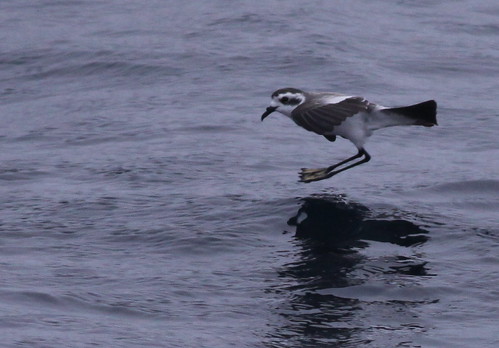
White-faced Storm-Petrel
Every late August for about five years now there has been a deep-water pelagic trip, which is to say a birding boat trip, that heads out to the Gulf Stream waters more than 100 miles south of Nantucket. It, along with a couple other such trips in June and July, have been dubbed the "Extreme Pelagics." They leave at 4am and get back at 9pm, and its a long day on a boat. This year, just for the August one, a new twist was put on the whole trip, by making it an overnight trip, from 5am the first day until 6pm a day and a half later.
I was scheduled on the one in late August, which I've gone on for four years now, and was slated for the weekend of the 22nd-23rd, originally anyways. Of course, the first hurricane of the season that made it up our way rolled through that weekend. So then it was the 29th-30th. And the second storm of the season came through, postponing it yet again. Well, this time the captain couldn't give us another weekend slot, so it was planning on going out on September 3-4th, a Thursday-Friday gig. The only problem for me is that weekdays don't quite work, there being the slight issue that I have to work dawn-dusk 5 days a week, so I had to drop my name from the passenger list with regret. And I thought that was the end of that, that they would go out and find tons of amazing birds and I would be sad that I missed it and cry myself to sleep, all that good stuff. (Note: Crying would not have really happened)
But then while hanging out in the banding room on Wednesday, my phone rang with a call from Rick Heil, one of the leaders on the trip. The trip normally has four leaders, three spotters and a guy on the mic, calling the birds out to the 50-80 birders on the boat. Because of the repeated rescheduling, two of the leaders were unable to make it, and I was offered the position to be one of the leaders! As a couple of my friends kindly put it, "Wow, they must have been desperate." The only slight hitch was that I would be working both of the days. Normally I could have just asked Trevor, our head bander and reigning deity, and I'm sure that he would have said yes and I could have gone. It just so happened that Wednesday was the only day so far in the entire season that Trevor was gone the whole day, at a conference up in Newburyport! No cellphone to contact him by, no number to reach him at, and as a bonus the power was also off on the premises, and there was nobody in the office building at Manomet.
My only method of contact was his home number, which I called and luckily his wife, Linda Leddy, another great human being and former president of Manomet for longer than I was alive, answered. I hung up that phone call with a wifely assurance that it would be it would be fine, and I should just go along with it. Well, a wifely assurance counts for a lot, and despite my agony at not being able to get in contact with Trevor, I part regretfully and part happily called Rick back and accepted the leader position. I still have not seen Trevor, and won't until Tuesday! We'll see how it goes.
As it turns out, the other replacement leader was Mark Faherty, a birder and friend who lives less than 1/2 mile away, the only other birder in White Horse Beach! What are the odds.
Thursday the third:
So after finishing the rest of the banding day on Wednesday, I went to bed early, set the alarm for 3:15, and got as much sleep as possible. A few hours later pre-dawn saw me standing around with about 35 other birders in downtown Hyannis, all of us preparing to be extreme. After leaving a little bit later than scheduled we were on our way, with a couple flyover Black-crowned Night-Herons and a few Least Terns, getting late for the terns, spicing up the harbor area. An hour or so later as we started rounding Nantucket we started getting into some Black Terns, and we saw over 90 Black Terns in the next few minutes, in flocks from 2-20 or so. Nice start. Not much else of interest until we got onto the Nantucket Shoals, an area that can be very productive, and after seeing a small pod of Harbor Porpoises, a life mammal for me, a large cloud of birds was spotted on the horizon, seemingly mostly terns from a distance. As we got closer, it turned out that they were indeed mainly terns, and estimates varied from 2,000-6,000. There were also some shearwaters scattered under them, with the bird highlights from the beginning of the flock being Manx and Sooty Shearwaters, as well as Forster's and Roseate Terns. Just as we were wondering where the jaegers were, a small grouping of them were spotted in the distance, and as we watched they landed on the water. What choice did we have but to head over there as quickly as possible? As we neared the group of birds on the water, a bunch of shearwaters with seven jaegers mixed in, they were originally called out as Parasitic Jaegers, with a couple birds that seemed to be Long-tailed as we got closer. In the initial hour or so after seeing these birds, at different times the flock was thought to be all Long-tailed, no Long-tailed, or any mix of in between numbers. After review of pictures, I think that there were five Long-tailed and two Parasitic, some others think the same, and some think four Long-tailed and three Parasitic. In any case, they put on an AMAZING show after they took off, as they repeatedly made passes at the bow of the boat, coming within 25 feet quite often. It's always a good thing when you can't fit an entire Long-tailed Jaeger in the frame of the picture.
After a nice show on the Shoals, we resumed steaming south, with not much new or different on the way out, a couple Minke Whales, some Short-beaked Common Dolphins, and pretty much the same birds. A couple more Long-tailed Jaegers made appearances, including one dark juvenile.
Our first destination was Hydrographer Canyon, a deep-water canyon that cuts into the continental shelf off of the Gulf Stream, our ultimate destination. I don't remember the exact locations of the best birds, everything got lost in the excitement, but the majority of good birds were had once we got out into the Gulf Stream proper, where there was water that was consistently 79.2 degrees Fahrenheit, and deep too. The birding was really good out there, and of course got good late in the day, when we were running out of light. The undisputed highlight of the first day were THREE White-faced Storm-Petrels, a bird that shows up in the US only a handful of times annually. Four Band-rumped Storm-Petrels were also really good, as well as being a state high count, and a final daily tally of 25 Audubon's Shearwaters was also a state high count. For mammals, there were Offshore Bottlenose Dolphins, Risso's Dolphins (also known as Grampus), and my personal favorite, a Cuvier's Beaked Whale that breached a couple times off of the bow before surfacing once, and then never being seen again, another life mammal. I had also been feeling a bit under the weather as the day progressed, and had to spend some time on the stern during the afternoon. I was feeling better as darkness approached, and thought that I was fine. As soon as the sun set, I knew I was wrong.
Apparently, once I lose sight of the horizon, I'm a goner. It was my first time being seasick. I ended up being the sickest person on the boat that night, and didn't make it inside until almost 11pm. The fact that it was pouring, POURING rain didn't help very much. I ended up sleeping fitfully on a bench with my legs hanging off of the end. What a night.
Friday the fourth:
Dawn, well, dawned. It was still drizzling, so no epic ocean sunrise, nor sunset the night previously, it was kind of damp and gray. I was still feeling a bit fuzzy around the edges in the morning, so I spent a bit more time on the stern in the morning. We woke up in the 79 degree water this day, so the good birds started right off of the bat. By mid-late morning or so I was feeling a bit better, and a phenomenal three MORE White-faced Storm-Petrels and four MORE Band-rumped Storm-Petrels helped for sure, as well as kind birders gifts of scopolamine patches, ginger pills, oyster crackers, and water. Once I felt good as new again I started making my way back up to the wheelhouse on the upper deck, and WHILE I was walking through the boat, a "tropical tern" was announced over the speakers. "Tropical tern" means either Bridled or Sooty Tern, both of which only breed off of the Florida Keys in the United States, and either of which would be a lifer for me. Needless to say, I started almost running on the pitching boat, and was lucky to make it topside alive.
Sure enough, just off of the bow of the boat there was a Bridled Tern sitting on a piece of wood, a typical behavior of this species, and the only piece of wood we saw the whole time we were out there! What are the chances. The captain skillfully maneuvered us within about 40 feet of the bird, a worn and molting adult, and great looks and photos were had by all. The most amazing part of the whole experience was that while we were watching this bird at one point it calmly bent its head, stuck its bill in the water, and came up with a fish! A fish! Apparently this one small fish had chosen the wrong piece of wood to hide under. Eventually the bird flushed and we gave chase, when all of a sudden the captain, not a birder, and without binoculars, goes "hey, there's another one!" and points out the right window. Sure enough, a second Bridled Tern. Seconds later someone calls out another one off of the bow. Three. In the next couple minutes we ended up with a total of five Bridled Terns, yet another high count for the state. Incredible. When it rains it pours.
After this wonderful experience it was getting time to head back for the six hour ride back to port, so we sadly left the warm waters and headed back across the continental shelf through Muskeget Channel, the passage between Martha's Vineyard and Nantucket. Birding was very slow on the way back, but it frankly didn't really matter any more. A Pomarine Jaeger that flew with us right off of the bow for a while was great for photo opps. As we were passing through the channel, there was an exposed sandbar with some Gray Seals on it, another mammal for the trip list, and there was a Parasitic Jaeger harassing some Laughing Gulls nearly.
I think everyone was happy with the trip, I don't see how you couldn't be, and most people got at least one new bird I believe! I for one was partially glad to be back on land, but I will look forward to the next trip out there. It sure was one Extreme Pelagic.
Thursday, August 27, 2009
I still exist!

Me with a Red-shouldered Hawk.
Since the first day of Panama, I got sick on the second day, spent the rest of the trip in a state of semi-sanity, and ended up missing about 70 species of the trip, getting 336 of the ~410 species that we three people saw.
Since then, I've moved back from DC to my normal home, in Mass, and have worked an entire spring banding season, April 15-June 15, as well as many other things. After banding this spring ended, I worked an internship for the New England Coastal Wildlife Alliance (NECWA), doing surveys of pelagic (ocean-going) seabirds out on Stellwagen Bank, an underwater hill off of Provincetown, MA, that is about 25 miles long, like a 100' tall hill of sand. This geographical deformity creates an upwelling of nutrients at the edges that attracts birds, as well as whales. Because of the whale angle, I was working on commercial whale-watching boats based out of Plymouth, Captain John Boats being the company that I worked on. It was lots of fun, and I got to do 22 whale-watches this summer, which was quite thrilling. As well as seeing about 40,000 birds during those trips, I got to see whales on every trip! For anyone who wants to see whales, Captain John Boats guarantees sightings of whales, and it's $40 for a ticket. Highly recommended. Some pictures that I took during my time on the ocean this summer can be seen at: http://picasaweb.google.com/goshawk227/CaptJohnBoatTrips2009#
Although I did go out on the ocean a lot, I also had lots of time for birding this summer, much of which I spent on Plymouth Beach, mostly looking at shorebirds and terns. One of the cool things about Plymouth Beach is that it is the second southernmost nesting site in the world for Arctic Tern, and, starting this year, the northernmost nesting site in the world for Black Skimmer! Black Skimmers are incredible birds, and the beach was graced with one pair of them this year, the first nesting north of Cape Cod in over 20 years, when they historically nested here on Plymouth Beach back then. Other great shorebirds have been around, and I'm up to 31 species of shorebirds (sandpipers/plovers, etc) for Plymouth County this year. Great birds. Pictures from this summer in Plymouth are at: http://picasaweb.google.com/goshawk227/PlymouthAreaSummer2009#
I also made a few trips out to Western Mass, which was amazing, some really cool birds breed out there, and the habitat is like you're in northern New Hampshire. Some of the better birds included Olive-sided Flycatcher, Common Moorhen, and Black Vulture, all very rare and local in Mass. As a matter of fact, they were all my second personal records ever for the state.
The birding highlight of the summer though would have to have occurred at my feeder in Manomet.
I was sitting at the computer, checking my email, and when I'm at the computer I have a view of the feeders. The birds flushed, from what I'm not sure, but for some reason I happened to glance over. I saw the usuals, but one of the doves had white bars across the wings and a squared off tail. My reaction was "Oh hey look, a White-winged Dove....wait, I'm in Mass, OH MY GOD thats a White-winged Dove."
It was the 7th documented state record of White-winged Dove for Massachusetts, and my 159th species for my yard. It was found on August 6th, it stayed for 7 days at my feeders, and was seen by over 30 different birders who traveled from around the state to come see it. Very cool. Some pictures of it can be seen at: http://www.flickr.com/photos/54107105@N00/sets/72157621842285037/
Now, I'm back working at Manomet Bird Observatory, bandin' birds and takin' names. I'll be working here until November 15th (started on August 15th) with Jess Johnson and Evan Dalton, the same two banders who I worked the spring season with. I also worked with Evan last fall here. Great people, good birders, and two of my closest friends. That still doesn't stop us from competing to see who can see more species in Plymouth County this year though..! I'm going to try to keep the posts coming more regularly, such as whenever I find an interesting bird, or if we band something cool. So far it's pretty much all Gray Catbirds, our bread and butter species here, but we did catch a Red-shouldered Hawk here the other day! Only the third banded here in 40 years, and a bit of a difference from our usual songbirds. For perspective, an average catbird has about an 88mm wing, and weighs about 37g (we are metric here). So about a 3.5 inch long wing and 1.3 ounce weight. Well, this hawk had a 337mm wing (13.25in) and weighed 515g (1.14lb)! Slightly different. The header picture is this individual.
I was supposed to be going on a two-day long boat trip last weekend, but it got hurricaned out, and therefore postponed to this weekend, but it looks like we're going to get pounded again! Supposedly 15-18' waves, 50-75mph winds, and 3-6" of rain in the Plymouth area. Should make for good seawatching from land. Sooty Terns anyone? I'll let you know how it goes.
Take it easy, and good birding,
Ian Davies
Manomet, MA
Tuesday, March 17, 2009
First day in Panama
My mom and I arrived in Panama last night with a mostly uneventful flight, only having a 30m delay in leaving Miami. As we stepped off the plane we were hit by a gust of warm hot air: welcome to Central America. As of 10am this morning the temperature was already over 85 and rising.
After making it through customs we got a taxi to take us to our imagined destination, Luna's Castle, which we were mildly disturbed by, judging by the partially clad people hanging over the balcony on the second floor, playing on guitars, singing, and generally carousing. Not a bad place, but we imagined that the amount of sleep gotten wouldn't be as much as we required. So our very nice taxi driver took us to another place, Hotel Latino, which is pretty crude, but at least has wifi downstairs and hot showers. It worked for one night. Of course now, we had to meet up with Andrew and Ethan who were headed for Luna's, unknowing of our abandonment of that hostel. When I got online I found out that Ethan had been stranded in Atlanta by inclement weather, so all that we had to get was Andrew. Luckily he had his wits around him, and checked his voicemail when he got to Luna's, and managed to hitch a ride with the National Police to Hotel Latino for a cool $2.
After all that was all gotten out of the way, and we were finally together, all was good.
This morning we got up at 0645 to head off to the Metropolitan Park in Panama City, and got a taxi there, and after paying the entrance fee to the park, the fun started. We managed to tally about 60-70 species, not sure of the exact number, but we got some great stuff. Some of the tougher birds that we got were Crane Hawk, very rare in the canal zone, Rosy Thrush-Tanager, Indigo Bunting, which is not on the list for the park, and Southern Bentbill. Some of my personal favorites, although not hard, include Green Shrike-Vireo, SEEN, Crimson-backed Tanager, upwards of 15 Bay-breasted Warblers, Lance-tailed Manakins, Slaty-tailed, Violaceous, and Black-throated Trogons all seen from one spot, and Rufous-breasted Wren wasn't too shabby either. There were some fun mammals too, we had Coatimundi, Howler Monkeys, and unidentified Tamarins, an Agouti, and some squirrel.
This afternoon we're heading off to pick up the car, enough taxis for now, and heading off for some more afternoon birding before picking Ethan up tonight at 7:15 from his rescheduled flight.
After that, Pipeline Road tomorrow, most likely Nusagandi the day after, picking up Caity, and then off to the west and to Davíd!
Take it easy,
Ian
Sunday, March 15, 2009
DC and Panama
I've been a bit lax in updating this blog recently, and that is putting it mildly. Since seeing the Ivory Gull in January, ANOTHER Ivory Gull showed up a few days later, on Inauguration Day in fact, and it happened to be in Plymouth, my local area! Needless to say, I saw that bird a total of four times during its stay, and at one point I had seen Ivory Gull 6 out of 8 days!
Take it easy, and good birding,
Ian Davies
Manomet, MA
goshawk227@earthlink.net
www.pbase.com/daviesphoto
http://picasaweb.google.com/goshawk227
After those thrilling couple weeks it was time for me and my mom to move down here to Washington D.C., more specifically Arlington, VA, where all three of us have been living in a one bedroom apartment while my dad is working a temporary detail for the FAA in DC.
It's been fun living down here, and birding in 2.5 states with a bunch of good birders and good people, but I will be glad to head back up to Massachusetts and to Manomet, where I will spend the spring banding at Manomet Center for Conservation Sciences, formerly known as Manomet Bird Observatory (MBO). Currently I'm mildly peeved that there is a male Tufted Duck having a blast with his friend a male Eurasian Green-winged (Common) Teal in Sudbury, not too far at all from Medford. All I can hope is that it will stick around until April 9th, when I finally return to where I normally belong!
Birding down here in the DC area has been lots of fun, and it would have not been nearly as productive without the nice and fun birders down here, especially Paul Pisano and John Hubbell, who have been kind enough to cart me around most weekends to god knows where, looking for various and sundry birds from DC to the Chesapeake. Thanks guys, you've really made my stay down here all the more pleasant.
Some of the cooler birds that I've run into while I'm down here include my first Tundra Swans, terrible, I know, and my first Brown-headed Nuthatches, little balls of adorable squeakiness frolicking around on trees. Hard to beat. Other cool stuff, not so awe inspiring for a northerner, but pretty crazy for down here, include a Barrow's Goldeneye, a White-winged Crossbill, and and White-winged Scoter in DC. Slight contrast from seeing over 7,000 White-winged Scoter go by Manomet Point last fall in two hours.
By now you're probably wondering where the "Panama" part of the title comes in. In 24 hours I will be on a plane headed to Miami, with a final destination of Tocumen International Airport, Panama! This all started when I was talking with Andrew Spencer, a mostly young birder from Colorado, who I met at the Ivory Gull, and we happened to be talking about international travel, always a fun topic of conversation. Just for kicks I checked the fares to Panama, and I found that I could get roundtrip airfare for $318! (!!) Needless to say, within three days we had booked plane tickets and were planning a ten day trip to Panama (March 16-26th)! In the next two days we managed to find two more young birders who could also swing a trip on less than two weeks of notice. So with our trip rounded out by Ethan Kister of Ohio and Caity Reiland-Smith of South Dakota, we're headed off for adventures of the birdiest sort.
Our plan is to spend most of the time in "canal zone" as it's known, with 3-4 days over near the Costa Rican birder in the Volcán Baru area, and one day with a short venture east to Nusagandi/Bayano Lake area for some eastern species.
My mom is also going to Panama, but not with us bird nuts. She is flying down with me, and we're all spending the first night together, with the exception of Caity who is arriving a few days later, and then we're splitting off the next morning, and will be apart until the last night, when we're meeting at the place where we spent the first night, Luna's Castle, for our last night in country.
Some of the cooler birds we're hoping for are Black-crowned Antpitta, Rufous-vented Ground-Cuckoo, and Resplendent Quetzal, along with hordes of others. 400 species is our, mildly unrealistic, goal for the trip, at least from my perspective.
I don't know how much internet access I'll have during the trip, but I will try to stick in a quick post whenever I can.
Take it easy, and good birding,
Ian Davies
Manomet, MA
goshawk227@earthlink.net
www.pbase.com/daviesphoto
http://picasaweb.google.com/goshawk227
Subscribe to:
Posts (Atom)