The past few days were quite memorable, with many things seen and heard that will be remembered for a long time.
We ended up hiring a pick-up truck for three days, which came with its own driver, and at the end of three days of constant togetherness, we still never knew his name! He was nice, probably thought we were crazy from the music that we played over the radio in the car, via the very modern MP3 hookup for our iPods, not to mention the fact that about every 500m we would yell "STOP!" to get out and run around in the puna grasslands above treeline, looking for some small brown bird with a name like Creamy-breasted Canastero, or something of that ilk. In any case, he drove well enough, helped communicate with the locals, and tolerated us enough. We also paid for his food during our time together, and he was particularly keen about eating as much as possible, as often as possible.
The road itself wasn't that bad, but it was definitely a long haul. We probably spent more than 20 hours in the car during the few days. On our way over we got caught in an epic hailstorm too, only about the size of tic-tacs, but so much that it covered the ground with about two inches of ice pellets. Very cool. The scenery was breathtaking, with knife-edge peaks, plunging river valleys, and cloud enshrouded ridges everywhere you cast your eyes. The birding was also spectacular, with lots of flocks at the temperate forest we birded near the Puente Carrizales, in english the Bamboo Bridge, and a very high endemism rate, as well as some species that just aren't official yet, being discovered so recently.
The first day our goal was to get to what we thought was the town of Carrizales, in order to camp there in preparation for birding the next morning. Well, after asking many locals for directions, and going by the crude maps that the bird finding guide to Peru gives, we ended up driving in the dark, over an hour past the location of the supposed town. Of course, nobody who gave us directions to "Carrizales" thought to tell us that it was just a bridge and a locale, and nobody actually lived there. We ended up staying near the next town down from there, Calabaza, where we ate in a subterranean restaurant, almost completely in the dark, along with about 5 locals and a TV blaring latin american music videos at deafening volume. It was one of the more interesting meals I've ever had. We camped just up the road, and by we I mean Andrew camped on the side of the road and I slept in the trunk of the pickup, diagonally, and not very well. As we drifted off to sleep we were heralded by a screech-owl, which turned out to be a Koepcke's Screech-Owl, a Peruvian endemic, and not the easiest bird to get.
We woke up at about 0430 the next morning, and proceeded to drive an hour or so back up to Puente Carrizales, hearing Chestnut-breasted Wren along the way, along with Andean Solitaires and Glossy-black Thrushes. Once up at the top, the birding commenced for real, and it was quite superb. Some of the highlights included Fire-throated Metaltail, Sword-billed Hummingbird, Paramo Seedeater, Tschudi's Tapaculo (seen), a male Purple-backed Thornbill, both on our list for one of the best birds of these few days, over 35 Scarlet-bellied Mountain-Tanagers, Drab Hemispingus, and tons of more common hummingbirds, including Tyrian Metaltail, Violet-throated Starfrontlet, and Amethyst-throated Sunangel. As we proceeded down the road to a lower elevation we hit some more flocks, and at one point a Barred Fruiteater flew by and perched near the road. Playback wouldn't bring it in, but it brought another one in, and we got gorgeous views from about 15 feet away at eye level of a female Barred Fruiteater. Just when we thought it couldn't get any better, a male came in and started FEEDING the female, right in front of us. The light was bad, so the pictures aren't crystal clear, but I managed to get a bunch of pictures of the male feeding her. Sometime soon I need to upload some pictures.
After walking the road we got back in the car and headed to higher elevations, hoping for some of the more local birds, but first we needed a stop for lunch and gas. This involved picking up some Quechua woman from the side of the road, giving her a ride to the town nearby, a town of about 15 buildings, and then her manually pumping gas from a barrel into a metal pitcher, which she then covered with a cloth, because of course it was pouring down rain, and running to the car where our driver was covering the opening to the gas tank with a jacket, and pouring the pitcher of gas in, then repeating. This happened about 5 times, and only amounted to about 1/4 tank. Since the town didn't have a restaurant, we shopped at the little store, which had about 8 items, all of them either canned fish, drinks, or crackers. We got some peach nectar, soda crackers, and for the other two meat-eaters, sardines. It tasted great. After a little more birding in the pouring rain, when we got Tit-like Dacnis, we started the journey to our destination that night, the town of Acobamba, above which reside the incredibly local Black-spectacled Brush-Finch, described to science in 2002, and two yet undescribed species, "Mantaro Thornbird" and "Mantaro Wren". En route, during the 6 hour drive, Andrew pulled out his laptop, saying "I bet this is the last thing that our driver just expected me to get out", and checked spots for the third undescribed species in this area, "Millpo Tapaculo". It turns out that the spot was only a few hundred yards down the road from that point, so just in time! We got out, played the recording once, and boom, a few hundred feet away one responded. Of course it was on the top of a 60' cliff, so we just had to get up there. We went up a sloping pasture that took us to the top, and after some effort and playback, saw the bird out in the open from less than 15 feet away, photographed well, and recorded incredibly well. With that under our belt we headed down into the Mantaro River valley, where Acobamba is located. Gorgeous scenery going down all of it, and Creamy-crested Spinetails were the nicest birds we had. We arrived at Acobamba after dark, and were surprised to see a military checkpoint at the entrance to the town, with a gate and four guys with guns standing around, none of them seemingly older than 25. They checked our passports and let us in, per usual, and it turns out that this town has a large military presence, and an outpost that was just swarming wth cadets. We found out why later. We went to the only restaurant in town, which was owned by the same people that had the only hospedaje in town, and we patronized both that night. The meal was quite nice for $1 per person, a plate with tons of vegetables and rice, and no meat! Might be the only time this trip that happens. While waiting for our food, we could see the military building, and also one of the funniest sights I've ever seen. There were a couple cadets out front, and they took turns posing with their guns in heroic poses, while the other one took their picture with a nice digital camera, and then they would huddle over the camera to check out the picture, and usually take some more. So hilarious. More than just a couple people did it too, we figured it must have been a new shipment of soldiers, straight out of school.
After a night at the hospedaje, which was five beds on the second floor of someones house, accessed by steep stairs in a dark alley, we headed up the mountain directly above Acobamba, to a little town called Chucho Acha, above which are "Mantaro Wren" and Black-spectacled Brush-Finch, or so we hoped. We really had no idea where to go, but after asking the store owner in the three-building "town" where the previous gringos with optics had gone, he took us on a trail further up the mountain to a large patch of bamboo, exactly what we wanted. We only had a 20 sole note to pay him, so he was very grateful, 20 soles being at least twice what we would have paid otherwise, and he headed back down to the village, while we hung around and birded. The bamboo patch turned out to not have much of anything, but we struck paydirt on a trail leading downhill past it. At least three Black-spectacled Brush-Finches were singing, and responded to playback of their song for about 30 minutes, while we had gorgeous looks at this perhaps most beautiful of brush-finches, and continued the trend of photographing and recording it. Now we only needed the wren, but they are a bamboo obligate, and things were looking grim in the bamboo department. We walked a bit further town the trail, and while looking through a small flock, we heard a pair of wrens singing! This was great, because it means we could cut another day at our backup spot for the wren and brush-finch. We eventually managed to get incredibly close to the wrens, a pair and a juvenile, and photographed and recorded them as well, partially in the pouring rain. Joyful at our success, we headed back to the car and proceeded back down to Acobamba. On our way back down we picked up a couple locals to give them a lift back to town, and one of the even spoke a small amount of english! One of the surprises of the day, but not as surprised as we were about to be. Tired of the ominous foreshadowing yet?
On our way back into town we passed a small group of soldiers, and out of curiosity asked the locals what they were here for. They replied "For safety". Safety from what we naturally asked, and got the answer "Terrorists". Turns out after some more questioning, that there is a decent terrorist faction in that area, both for political reasons, drug reasons, and some of them are even leftovers of the Shining Path, or Sendero Luminoso. That was slightly sobering.
Glad that we had learned about this on the last day, we started making our way back, with a few stops for the endemic "Mantaro Thornbird", which we finally heard distantly at one place, breaking our streak of photographing and recording every rare species in this area. What can you do. After a lunch of potatoes and rice at a small town, we started the 6 hour drive back to Huancayo. I managed to sleep a bit, but was still awake when we had Giant Hummingbird from the car, and also woke up to take some pictures of the gorgeous vistas. We had one bird that we still wanted to see well, and decided to stop at this likely looking spot for Eye-ringed Thistletail, another endemic to just this area. We almost immediately had one, and eventually got within about 8 feet of this bird, having it singing, walking on the ground, and all in all performing wonderfully for us, and this one caved to the formula of great pictures and recordings. We ended up having a few thistletails at this spot, as well as many "Millpo Tapaculos" and a Fire-throated Metaltail.
The rest of the drive was pretty uneventful, just long. A nice Aplomado Falcon spiced things up at one point, and getting cell service to check my email again was joyous. We made it back to our hotel at about 7pm, and after trying to get charged $70/day for the car instead of $50, we managed to haggle him down to about $20 more than 50 a day. Ah well, we just wanted to get fed and sleep. We went back to the same hotel and restaurant as we did last time we were here, and had a great meal of french fries and salad for me, and fries and steak for Andrew. My parents kindly treated us to this Thanksgiving dinner, and also kindly reminded us of the fact that it was Thanksgiving indeed! Thanks Mom and Dad!
I write this from our hotel room, as we prepare to eat and then head to the Ticlio Pass/Marcapomacocha area to bird tomorrow, hopefully for Diademed Sandpiper-Plover and White-bellied Cinclodes, two very special birds.
Also, as a footnote, here are some things that I didn't cram in the above writings, but deserve mention nonetheless:
A herd of llamas charging down the road towards us, about 35 of them, taking up the entire road.
An old Quechua lady walking calmly down the side of the road, knitting as she went.
A roadblock that was done by three kids that were about 6-8, asking for money. Our driver talked them out of it and let us pass.
Happy belated Thanksgiving to all,
Ian
Friday, November 27, 2009

Tuesday, November 24, 2009
Villa Rica and Huancayo
As I write this I am in my bed in our hotel in Huancayo, not to be confused with Huanaco, the last city I updated from. We are currently living in the lap of luxury, and only for a measly 80 soles per night, which equates to $13 per person per night, for a nice hotel with cable TV, hot showers, and wifi in the rooms. Gotta love it.
The past few days were spent in a small town called Villa Rica, which was accessed from Huanaco by a 5 hour bus, a 3 hour collectivo, and another 1.5h collectivo. It's a big country with bad roads. Villa Rica was a surprisingly large town for being in the middle of nowhere, with at least a few thousand people living there. It was also at the lowest altitude that we had stayed at so far, at around 1400m (about 4600'), and the habitat there is more upper foothills and lower subtropics, as opposed to the drier high elevations that we had been at. It was great being at low elevations, no altitude sickness of any sort, but of course I couldn't possibly be well for more than a couple days, so I just had to get food poisoning. The main suspect was a juice I got that was mango with milk. I was a bit tentative about the milk anyways, and now I will avoid it like the plague. Plus it didn't even taste good..!
We had two main target birds while at Villa Rica, namely Creamy-bellied Antwren and Scissor-tailed Nightjar, both birds we had no chance for on the rest of the trip. I'm a huge fan of spectacular nightjars, so I was really hoping to be able to get that bird. We went to the spots at dusk where they are supposed to display, and had no luck. Ah well, some other trip I guess. We were more lucky with the Creamy-bellied Antwren, hearing and seeing that Peruvian endemic, but Andrew was unable to get a recording sadly. There were other good birds around too, many of them Andrew had already had in the south when he was here in Peru two weeks before me, but many were new to me. There was a good tanager show overall, with Turquoise, Paradise, Spotted, Blue-necked, Yellow-throated, Silver-backed, Golden-eared, Saffron-crowned, Flame-faced, and Swallow Tanagers leading the charge, along with many Blue-winged Mountain-Tanagers, and a couple Scarlet Tanagers. Who knows, maybe I saw the same Scarlet Tanagers this summer in MA? No way to know. Some other nice birds included White-eared Solitaire, a stunning member of its family, and some great marshbirds at the marsh right near town. The marsh is fairly large, and at 1400m is kind of an interesting habitat. We had great luck there in the late afternoon, SEEING at least 5 Rufous-sided Crakes, hearing Blackish Rail, getting to see Least Grebe in flight, and having an interesting elevational record of two Yellow-billed Terns, normally a bird that hangs out in the Amazonian lowlands.
Of course, when I was sick I had to miss a couple birds that I wanted, but that is just a given. Andrew went out birding the afternoon that I was far gone, and had two birds that I was hoping to get, namely Bicolored Hawk and Lanceolated Monklet, which he had a family group of, four in total, so close that he was unable to focus his binoculars. Ah well, you can't get them all.
It was quite rainy down in the Villa Rica area, where it rained two of the three mornings that we were there, letting us get out for dawn chorus only once.
Yesterday we headed to where we are now, Huancayo, via a 1.5h collectivo and then a four hour bus. Pretty unexciting for the most part, but a juvenile Band-bellied Ow roostingl in a banana plantation between Villa Rica and La Merced was a nice thing to see, and a life bird. Now we are waiting to get a rental car to be able to bird the Satipo Road better than we could be able to if we camped, which was the original plan. The Satipo Road is a very interesting place, with the elevational range from 4500m (about 15,000'), to just a few hundred meters (less than a thousand feet), making it a very diverse and interesting place to bird. So interesting in fact, that there are at least three and maybe four species on this road that have yet to be described to science! They are recognized as seperate species, but someone has yet to study and officially describe them. There are also some local Peruvian endemics, such as Black-spectacled Brush-Finch, Fire-throated Metaltail, Eye-ringed Thistletail, and Koepcke's Screech-Owl, in addition to many other good birds.
I doubt I'll have internet access for the next few days, but when we come back to Huancayo after birding the road for 4-5 days I should be able to update again.
Take it easy,
Ian
Friday, November 20, 2009
First few days
The flights went well, I met Andrew at the airport, and after spending a night in Lima, we headed up into the mountains, with our final destination being Lago Junin. The 5 hour bus ride up the Junin was gorgeous, going through gorges with sheer rock faces sometimes thousands of feet high, and the pass over the western side of the Andes, Ticlio Pass (16,000 feet), was surrounded by gorgeous snow-capped mountains. Some of the bird highlights of the bus ride included Andean Goose, Andean Swift, White-winged Cinclodes, and Plain-breasted Earthcreeper. After getting to the town of Junin we walked through town until we got the the 'collectivo' area, the place where taxis hang around and charge a minimal fee to take you to a certain town, but you have to wait for the car to fill all the way up with random people. In this case, 6 of us were in a station wagon, with two people riding in the trunk. Luckily we got the back seat. For this 45 minute ride to Ondores, it cost 3 soles each, or $1. Once at the almost deserted town of Ondores, which is quite close to the Lago de Junin, we made our way to the only hospedaje in town, which cost us 5 soles ($1.66) a night per person.
I had never had any problems with altitude in Ecuador, but I think going from sea level to 13,500 feet, the altitude of Junin, in one day, was just too much for my body. I had a headache basically the entire time we were in the area, wasn't able to sleep, and got short of breath very easily. Our goal bird here at Lago Junin was the Junin Grebe, one of the rarer birds in the world, with only 200-300 left in the world. They are flightless, and only occur on this one lake in the entire world. The normal way of seeing them is hiring a boat, but the office where you do so never opened while we were there. Such is life. However, we managed to find a guy who knew how to walk to the edge of the lake, which was 4 kilometers each way, through mostly shin-deep water, chest high reeds, and mud. I only managed to make it about half of the way out, and by then I was just so spent that I wouldn't have been able to make it back had I continued all the way. I ended up making a small bed out of the reeds, pulled more of them overhead for shade, and slept there for close to an hour. Andrew and our guide continued on to the edge of the lake, and when they got there they still had to walk another kilometer along the edge of the lake until they found a Junin Grebe. But they did, and I'm glad that my infirmity didn't keep Andrew from seeing the bird. After a long walk back all of us were completely exhausted, even our guide. Following a quick lunch, where I actually got a small salad rather than the usual vegetarian fare here: potatoes and rice, we headed back to our room for a nap. When I woke up from the nap I felt completely miserable, and despite wanting to stay around to try for the grebe again in the morning, I really needed to get to a lower elevation. So we packed up, and headed back to the town of Junin, seeing a very cool Short-eared Owl on the way, so different from ours up here. In Junin while waiting for a bus to take us to Huanaco, our lower elevation destination, I had some matte de coca, or tea made from coca leaves, which is the traditional way of curing altitude sickness, at least temporarially. I felt better almost immediately after having it, and that managed to keep me going until the end of the 3 hour bus to Huanaco, which we arrived in at 9:30, not the optimal time to get to a new city. We got a nice hostal right on a nice plaza, and I finally slept, first time since Lima, and now we are at an internet cafe in Huanaco. That pretty much sums up the trip so far!
My phone hadn't been working until now, but after getting some tech support, aka my parents calling the Verizon people and then emailing me the answer, I am back online! Hopefully I'll be able to update this more often now.
We're leaving shortly for Villa Rica, a place that is mostly coffee plantations, but has some really cool birds, including Lanceolated Monklet, Scissor-tailed Nightjar, Creamy-bellied Antwren, Cerulean-capped Manakin, and White-bellied Pygmy-Tyrant.
I'll try to post a bird list sometime soon.
Ian
Monday, November 16, 2009
Last day in the first world
Well this is it, I just had my last home-cooked dinner for a while, am about to sleep the last night in my bed, and tomorrow night I'll be in a plane, and then in Lima, Peru. It'll be a bit different, but I'm looking forward to it more than just about anything.
As some of you may notice, there is now an option in the upper left-hand corner of this page to subscribe to this blog via email. If that is to your liking, the option is now there!
I also made a map for the places that we will be visiting, and you can see that at this link: map.
I'll try to update as often as I can from down there, I'll be at a place with wifi on the first night, so hopefully I'll post something quickly before I collapse.
In any case, I hope all of you have a great winter, and take it easy.
Good birding,
Ian Davies
Manomet, MA
goshawk227@earthlink.net
www.pbase.com/daviesphoto
http://picasaweb.google.com/goshawk227
http://www.flickr.com/photos/uropsalis/
Sunday, November 8, 2009
Peru primer
Some of you may know, and some of you may not, but in nine days I am going to be going to Peru. For three months. A lot of people may consider that a bit extreme, but after two months in Andean South America last winter, I wish I could go for four! There will be two of us for the entire trip, Andrew Spencer, a friend that I went to Panama with, and myself, and a third guy, Chris Nunes, will be joining us after a couple weeks, and staying for the remaining couple months.
Our goal, per usual, is to see lots of birds. Really imaginative, I know. However, if that is your goal in life, there are few better places than Peru to see hundreds upon hundreds of species of birds. In fact, we expect to see over 1,000 species during our time there, which is to say more than have EVER been seen in continental North America.
I'm hoping to be able to visit a lot of internet cafes while I'm down south, and I also recently got a new phone that will have internet and email capabilities as long as I have cell service down there, so I will be able to update from the field as well!
I will post again soon before leaving, and then hopefully every few days I'll be able to get some blurb on to the internet.
Take it easy,
Ian
Sunday, September 6, 2009
Extreme Pelagic

The first Bridled Tern with his fish
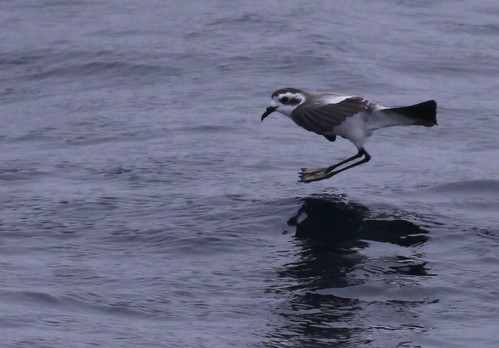
White-faced Storm-Petrel
Every late August for about five years now there has been a deep-water pelagic trip, which is to say a birding boat trip, that heads out to the Gulf Stream waters more than 100 miles south of Nantucket. It, along with a couple other such trips in June and July, have been dubbed the "Extreme Pelagics." They leave at 4am and get back at 9pm, and its a long day on a boat. This year, just for the August one, a new twist was put on the whole trip, by making it an overnight trip, from 5am the first day until 6pm a day and a half later.
I was scheduled on the one in late August, which I've gone on for four years now, and was slated for the weekend of the 22nd-23rd, originally anyways. Of course, the first hurricane of the season that made it up our way rolled through that weekend. So then it was the 29th-30th. And the second storm of the season came through, postponing it yet again. Well, this time the captain couldn't give us another weekend slot, so it was planning on going out on September 3-4th, a Thursday-Friday gig. The only problem for me is that weekdays don't quite work, there being the slight issue that I have to work dawn-dusk 5 days a week, so I had to drop my name from the passenger list with regret. And I thought that was the end of that, that they would go out and find tons of amazing birds and I would be sad that I missed it and cry myself to sleep, all that good stuff. (Note: Crying would not have really happened)
But then while hanging out in the banding room on Wednesday, my phone rang with a call from Rick Heil, one of the leaders on the trip. The trip normally has four leaders, three spotters and a guy on the mic, calling the birds out to the 50-80 birders on the boat. Because of the repeated rescheduling, two of the leaders were unable to make it, and I was offered the position to be one of the leaders! As a couple of my friends kindly put it, "Wow, they must have been desperate." The only slight hitch was that I would be working both of the days. Normally I could have just asked Trevor, our head bander and reigning deity, and I'm sure that he would have said yes and I could have gone. It just so happened that Wednesday was the only day so far in the entire season that Trevor was gone the whole day, at a conference up in Newburyport! No cellphone to contact him by, no number to reach him at, and as a bonus the power was also off on the premises, and there was nobody in the office building at Manomet.
My only method of contact was his home number, which I called and luckily his wife, Linda Leddy, another great human being and former president of Manomet for longer than I was alive, answered. I hung up that phone call with a wifely assurance that it would be it would be fine, and I should just go along with it. Well, a wifely assurance counts for a lot, and despite my agony at not being able to get in contact with Trevor, I part regretfully and part happily called Rick back and accepted the leader position. I still have not seen Trevor, and won't until Tuesday! We'll see how it goes.
As it turns out, the other replacement leader was Mark Faherty, a birder and friend who lives less than 1/2 mile away, the only other birder in White Horse Beach! What are the odds.
Thursday the third:
So after finishing the rest of the banding day on Wednesday, I went to bed early, set the alarm for 3:15, and got as much sleep as possible. A few hours later pre-dawn saw me standing around with about 35 other birders in downtown Hyannis, all of us preparing to be extreme. After leaving a little bit later than scheduled we were on our way, with a couple flyover Black-crowned Night-Herons and a few Least Terns, getting late for the terns, spicing up the harbor area. An hour or so later as we started rounding Nantucket we started getting into some Black Terns, and we saw over 90 Black Terns in the next few minutes, in flocks from 2-20 or so. Nice start. Not much else of interest until we got onto the Nantucket Shoals, an area that can be very productive, and after seeing a small pod of Harbor Porpoises, a life mammal for me, a large cloud of birds was spotted on the horizon, seemingly mostly terns from a distance. As we got closer, it turned out that they were indeed mainly terns, and estimates varied from 2,000-6,000. There were also some shearwaters scattered under them, with the bird highlights from the beginning of the flock being Manx and Sooty Shearwaters, as well as Forster's and Roseate Terns. Just as we were wondering where the jaegers were, a small grouping of them were spotted in the distance, and as we watched they landed on the water. What choice did we have but to head over there as quickly as possible? As we neared the group of birds on the water, a bunch of shearwaters with seven jaegers mixed in, they were originally called out as Parasitic Jaegers, with a couple birds that seemed to be Long-tailed as we got closer. In the initial hour or so after seeing these birds, at different times the flock was thought to be all Long-tailed, no Long-tailed, or any mix of in between numbers. After review of pictures, I think that there were five Long-tailed and two Parasitic, some others think the same, and some think four Long-tailed and three Parasitic. In any case, they put on an AMAZING show after they took off, as they repeatedly made passes at the bow of the boat, coming within 25 feet quite often. It's always a good thing when you can't fit an entire Long-tailed Jaeger in the frame of the picture.
After a nice show on the Shoals, we resumed steaming south, with not much new or different on the way out, a couple Minke Whales, some Short-beaked Common Dolphins, and pretty much the same birds. A couple more Long-tailed Jaegers made appearances, including one dark juvenile.
Our first destination was Hydrographer Canyon, a deep-water canyon that cuts into the continental shelf off of the Gulf Stream, our ultimate destination. I don't remember the exact locations of the best birds, everything got lost in the excitement, but the majority of good birds were had once we got out into the Gulf Stream proper, where there was water that was consistently 79.2 degrees Fahrenheit, and deep too. The birding was really good out there, and of course got good late in the day, when we were running out of light. The undisputed highlight of the first day were THREE White-faced Storm-Petrels, a bird that shows up in the US only a handful of times annually. Four Band-rumped Storm-Petrels were also really good, as well as being a state high count, and a final daily tally of 25 Audubon's Shearwaters was also a state high count. For mammals, there were Offshore Bottlenose Dolphins, Risso's Dolphins (also known as Grampus), and my personal favorite, a Cuvier's Beaked Whale that breached a couple times off of the bow before surfacing once, and then never being seen again, another life mammal. I had also been feeling a bit under the weather as the day progressed, and had to spend some time on the stern during the afternoon. I was feeling better as darkness approached, and thought that I was fine. As soon as the sun set, I knew I was wrong.
Apparently, once I lose sight of the horizon, I'm a goner. It was my first time being seasick. I ended up being the sickest person on the boat that night, and didn't make it inside until almost 11pm. The fact that it was pouring, POURING rain didn't help very much. I ended up sleeping fitfully on a bench with my legs hanging off of the end. What a night.
Friday the fourth:
Dawn, well, dawned. It was still drizzling, so no epic ocean sunrise, nor sunset the night previously, it was kind of damp and gray. I was still feeling a bit fuzzy around the edges in the morning, so I spent a bit more time on the stern in the morning. We woke up in the 79 degree water this day, so the good birds started right off of the bat. By mid-late morning or so I was feeling a bit better, and a phenomenal three MORE White-faced Storm-Petrels and four MORE Band-rumped Storm-Petrels helped for sure, as well as kind birders gifts of scopolamine patches, ginger pills, oyster crackers, and water. Once I felt good as new again I started making my way back up to the wheelhouse on the upper deck, and WHILE I was walking through the boat, a "tropical tern" was announced over the speakers. "Tropical tern" means either Bridled or Sooty Tern, both of which only breed off of the Florida Keys in the United States, and either of which would be a lifer for me. Needless to say, I started almost running on the pitching boat, and was lucky to make it topside alive.
Sure enough, just off of the bow of the boat there was a Bridled Tern sitting on a piece of wood, a typical behavior of this species, and the only piece of wood we saw the whole time we were out there! What are the chances. The captain skillfully maneuvered us within about 40 feet of the bird, a worn and molting adult, and great looks and photos were had by all. The most amazing part of the whole experience was that while we were watching this bird at one point it calmly bent its head, stuck its bill in the water, and came up with a fish! A fish! Apparently this one small fish had chosen the wrong piece of wood to hide under. Eventually the bird flushed and we gave chase, when all of a sudden the captain, not a birder, and without binoculars, goes "hey, there's another one!" and points out the right window. Sure enough, a second Bridled Tern. Seconds later someone calls out another one off of the bow. Three. In the next couple minutes we ended up with a total of five Bridled Terns, yet another high count for the state. Incredible. When it rains it pours.
After this wonderful experience it was getting time to head back for the six hour ride back to port, so we sadly left the warm waters and headed back across the continental shelf through Muskeget Channel, the passage between Martha's Vineyard and Nantucket. Birding was very slow on the way back, but it frankly didn't really matter any more. A Pomarine Jaeger that flew with us right off of the bow for a while was great for photo opps. As we were passing through the channel, there was an exposed sandbar with some Gray Seals on it, another mammal for the trip list, and there was a Parasitic Jaeger harassing some Laughing Gulls nearly.
I think everyone was happy with the trip, I don't see how you couldn't be, and most people got at least one new bird I believe! I for one was partially glad to be back on land, but I will look forward to the next trip out there. It sure was one Extreme Pelagic.
Thursday, August 27, 2009
I still exist!

Me with a Red-shouldered Hawk.
Since the first day of Panama, I got sick on the second day, spent the rest of the trip in a state of semi-sanity, and ended up missing about 70 species of the trip, getting 336 of the ~410 species that we three people saw.
Since then, I've moved back from DC to my normal home, in Mass, and have worked an entire spring banding season, April 15-June 15, as well as many other things. After banding this spring ended, I worked an internship for the New England Coastal Wildlife Alliance (NECWA), doing surveys of pelagic (ocean-going) seabirds out on Stellwagen Bank, an underwater hill off of Provincetown, MA, that is about 25 miles long, like a 100' tall hill of sand. This geographical deformity creates an upwelling of nutrients at the edges that attracts birds, as well as whales. Because of the whale angle, I was working on commercial whale-watching boats based out of Plymouth, Captain John Boats being the company that I worked on. It was lots of fun, and I got to do 22 whale-watches this summer, which was quite thrilling. As well as seeing about 40,000 birds during those trips, I got to see whales on every trip! For anyone who wants to see whales, Captain John Boats guarantees sightings of whales, and it's $40 for a ticket. Highly recommended. Some pictures that I took during my time on the ocean this summer can be seen at: http://picasaweb.google.com/goshawk227/CaptJohnBoatTrips2009#
Although I did go out on the ocean a lot, I also had lots of time for birding this summer, much of which I spent on Plymouth Beach, mostly looking at shorebirds and terns. One of the cool things about Plymouth Beach is that it is the second southernmost nesting site in the world for Arctic Tern, and, starting this year, the northernmost nesting site in the world for Black Skimmer! Black Skimmers are incredible birds, and the beach was graced with one pair of them this year, the first nesting north of Cape Cod in over 20 years, when they historically nested here on Plymouth Beach back then. Other great shorebirds have been around, and I'm up to 31 species of shorebirds (sandpipers/plovers, etc) for Plymouth County this year. Great birds. Pictures from this summer in Plymouth are at: http://picasaweb.google.com/goshawk227/PlymouthAreaSummer2009#
I also made a few trips out to Western Mass, which was amazing, some really cool birds breed out there, and the habitat is like you're in northern New Hampshire. Some of the better birds included Olive-sided Flycatcher, Common Moorhen, and Black Vulture, all very rare and local in Mass. As a matter of fact, they were all my second personal records ever for the state.
The birding highlight of the summer though would have to have occurred at my feeder in Manomet.
I was sitting at the computer, checking my email, and when I'm at the computer I have a view of the feeders. The birds flushed, from what I'm not sure, but for some reason I happened to glance over. I saw the usuals, but one of the doves had white bars across the wings and a squared off tail. My reaction was "Oh hey look, a White-winged Dove....wait, I'm in Mass, OH MY GOD thats a White-winged Dove."
It was the 7th documented state record of White-winged Dove for Massachusetts, and my 159th species for my yard. It was found on August 6th, it stayed for 7 days at my feeders, and was seen by over 30 different birders who traveled from around the state to come see it. Very cool. Some pictures of it can be seen at: http://www.flickr.com/photos/54107105@N00/sets/72157621842285037/
Now, I'm back working at Manomet Bird Observatory, bandin' birds and takin' names. I'll be working here until November 15th (started on August 15th) with Jess Johnson and Evan Dalton, the same two banders who I worked the spring season with. I also worked with Evan last fall here. Great people, good birders, and two of my closest friends. That still doesn't stop us from competing to see who can see more species in Plymouth County this year though..! I'm going to try to keep the posts coming more regularly, such as whenever I find an interesting bird, or if we band something cool. So far it's pretty much all Gray Catbirds, our bread and butter species here, but we did catch a Red-shouldered Hawk here the other day! Only the third banded here in 40 years, and a bit of a difference from our usual songbirds. For perspective, an average catbird has about an 88mm wing, and weighs about 37g (we are metric here). So about a 3.5 inch long wing and 1.3 ounce weight. Well, this hawk had a 337mm wing (13.25in) and weighed 515g (1.14lb)! Slightly different. The header picture is this individual.
I was supposed to be going on a two-day long boat trip last weekend, but it got hurricaned out, and therefore postponed to this weekend, but it looks like we're going to get pounded again! Supposedly 15-18' waves, 50-75mph winds, and 3-6" of rain in the Plymouth area. Should make for good seawatching from land. Sooty Terns anyone? I'll let you know how it goes.
Take it easy, and good birding,
Ian Davies
Manomet, MA
Subscribe to:
Posts (Atom)