Thursday, September 27, 2012

June 19 - bears


"Blondie" as we called him, about a mile away through a telescope, with the icebergs in the Arctic Ocean visible behind him

The last thing I saw before I entered my tent a couple minutes ago was a grizzly bear. It is after midnight, and I have spent the past couple hours or so watching a massive male bear feeding on the next ridge over from camp, a mile or so away. So, not quite as menacing as the first sentence sounded, but I’ll take it nonetheless.
This individual is very blonde, with a pale golden body offset by darker legs and muzzle. He is also a complete beast, with enormous shoulder muscles that ripple when he walks, visible from even a mile away, and just overall a hulking large animal. We watched him dig for lemmings, which consisted of him wandering around the tundra, periodically using his dinner-plate sized paws to tear up chunks of tundra the size of human torsos with about as much effort as flipping a coin. The ease with which he churned through the hard-packed ground was nothing short of impressive, a swift backhand from one of those same paws could surely send a human flying!
Part of the reason why we watched him for so long was so that we could be sure he wasn’t coming towards camp, since he halved his distance from us in the initial hour or so that we were watching. Once he started to head away everyone else went to bed, but I wanted to go photographing in the gorgeous light again so I went out alone. I ended up only being out for a brief while since my Buff-breasted Sandpiper quarry from a few nights ago were nowhere to be found. However, it was definitely quite an experience being out there alone knowing that there is a bear waltzing along a mile or so away.
A beautiful night to be out! The shadows are long at midnight.

Baird's Sandpiper right below camp after dinner


The other big news today is also of the mammalian persuasion – this one less menacing – in the form of caribou! Out working today we had had a half-dozen or so caribou, more than any other day leading up to now. Upon returning to camp at 6:30pm or so I took a look inland up the river floodplain, and as I scanned I saw dozens, then hundreds, and eventually over a thousand caribou, strung out along the horizon – an amazing spectacle.
Normally the big herds don’t move coastward until later in the summer, when they’re driven to the colder and windier river deltas and coasts by the tremendous numbers of biting insects. The insects that plague the caribou come in a few flavors, the most well known of which are mosquitoes. In addition, they also cultivate a few kinds of parasitic flies that make their lives miserable, but the mosquitoes can be so dense up there that the caribou can actually die of low blood pressure due to blood loss. A pretty inconceivable concept to life down here!
These herds can number in the tens of thousands, with over 50,000 being seen here a couple years ago. Normally numbers like this don’t arrive until at least August if they’re going to at all, but perhaps the very warm temperatures (50°F+ today again) have galvanized the animals into action due to an early bug hatch. Time will tell!
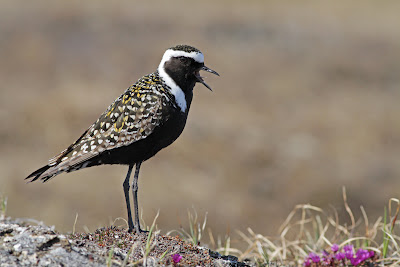
American Golden-Plover, one of the more striking birds in the area in my opinion

Going to bed with 1,000+ caribou to the south, a grizzly to the north, and 3-4 Arctic Foxes prowling around within view of camp – feels like the American Serengeti!

Stilt Sandpiper sitting on nest - they are always incredibly unconcerned with our presence

Wednesday, September 26, 2012

June 18 - Dunlin nests


This is a view I could get used to - taken from right outside the cook tent

Another gorgeous day here, this one being filled with many new nests as well! Most of the day today I didn’t even need my down jacket, which was a first.
Alfredo and I headed down to the sevens again, with the winds strangely out of the southwest in the morning, making us wary of more storms, but eventually swinging back around to the normal northeast.
The morning started off with our tri-daily invertebrate sampling, of which Alfredo and I did the aquatic section. There are three habitat types that we sample, one aquatic, one dry, and one intermediate. There are five standardized sampling locations in each habitat,  and each are done every three days. It was gratifying today to actually see inverts in the traps today, after having traps almost completely devoid of life the previous times I had sampled.

Alfredo strolling through the part of the study area known as the "sevens" - you can see his short sleeves and the heat shimmer over the ground!

We had eight new nests discovered today between the two of us, one Pectoral Sandpiper, two Dunlin, three Semipalmated Sandpipers, one Red Phalarope, and one American Golden-Plover. Not a bad day at all! Unfortunately we also had four nests fall prey to foxes, giving us a net of +4 nests at least.
One of the Dunlin was incredibly wily, leading us along for over an hour, and ultimately requiring two visits to the nest area throughout the day until we nailed it. An initial flush at over 100m away clued us in as to the presence of the nest, but the bird left the area and vanished from sight. A distant vigil laying in a ditch eventually convinced it that there was no threat in coming back, but we didn’t see it sit down on the nest, just the general area. An approach flushed it again, but we weren’t able to determine exactly where it came from since it was so far away. It was still in the area, so we watched it until it simply vanished in front of our eyes in what appeared to be short grass! We waited for another 20+ minutes before looking for it and it seemed to have just vanished, and didn’t flush from anywhere as we walked up. What a sneak!

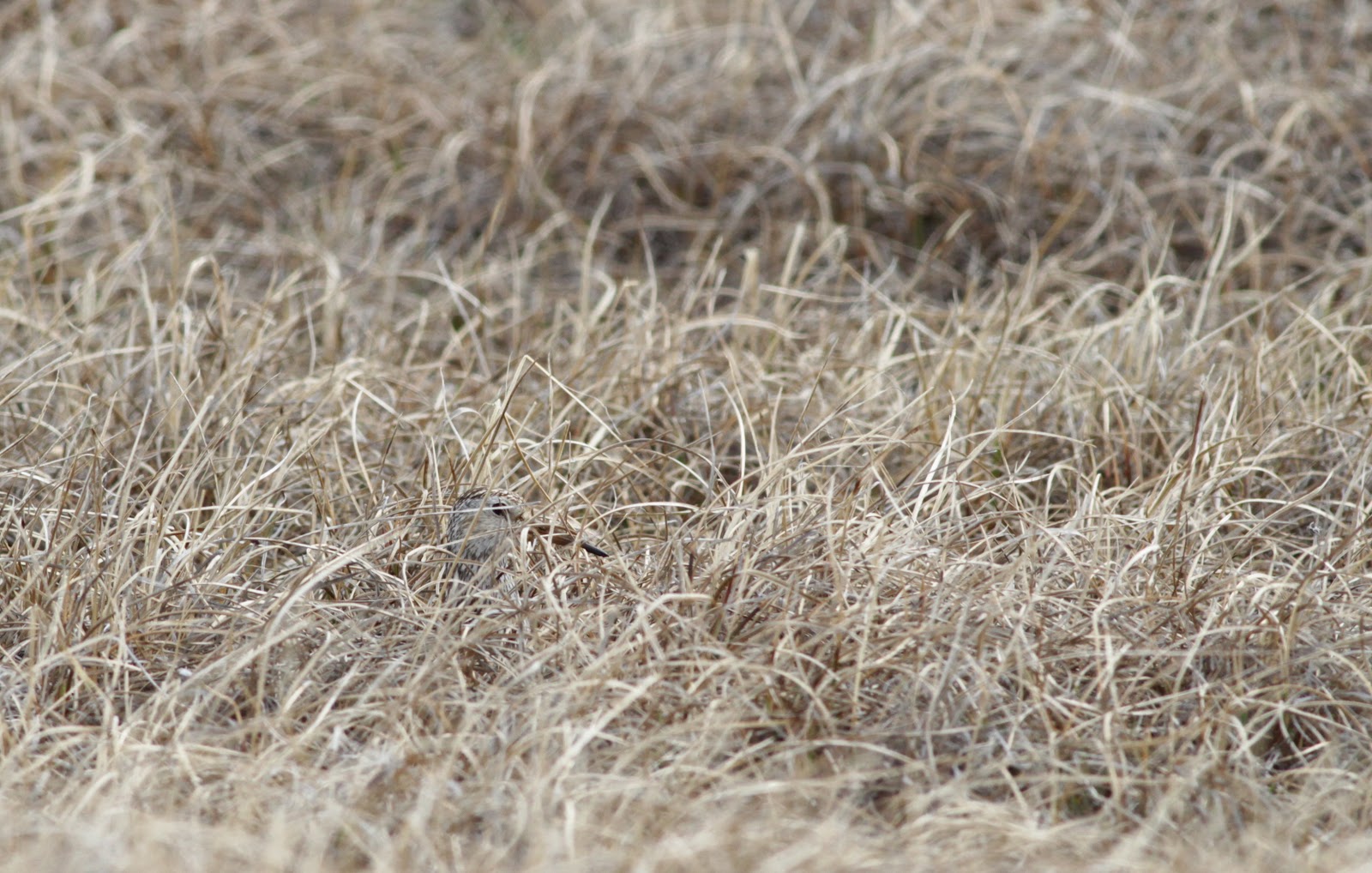
To give an idea of how well camouflaged all of these birds are, you can see a Pectoral Sandpiper on her nest just below and left of center here

Frustrated, we left the area but marked it to come back later. Upon returning in a couple hours we walked up, the bird flushed, and we found the nest within 5 minutes now that we had figured that bird out. Far and away the single most satisfying nest that I found out of my ~80 for the season!
It is now after midnight, I stayed up too late photographing on this perfect evening, how can you not when the light is so good? Almost summer solstice. 

This gorgeous pair of King Eider served to brighten up an already great day!

Tuesday, September 25, 2012

June 17 - Pectoral Sandpiper


A gray day out by the Arctic Ocean

Today the string of good weather finally snapped, heralded when I awoke to the sound of rain drumming on my tent fly. It is interesting how the sounds of our tents say so much about the camp life, from being weather indicators or just letting you know where the lemmings are when you hear the scratching.
I know I always start each day off with a weather report, so cliché, but when your whole life is lived outdoors, the weather matters! It stayed clear most of the day, until we were walking back to camp around 5pm when we got to enjoy a half-hour trudge in sideways rain blowing in our faces. After we got back to camp it even hailed a bit! The interesting thing about all of this precipitation is that it is technically a desert by rainfall amounts here, so to have rain at all, much less at this time of year, is unusual.
For contrast, a nice day. If you look along the edge of the green on the left side you can see the camp tents, very tiny in the distance

The running joke around camp whenever it drizzled or snowed or hailed would just be “Drier than Tucson!”, which technically it was. Not necessarily the wittiest thing ever, but when you’re in the middle of nowhere any humor is good humor.
Another anomalous weather pattern today were the winds, which were from the west, the direction that brings bad weather like summer blizzards, which don’t usually come until July. Our normal wind direction is from the northeast, biting cold coming off of the great expanse of the Arctic Ocean pack ice.
I found four nests today, including two of the cagier Pectoral Sandpiper, harder to find than the very numerous Semipalmated Sandpiper, the latter of which makes up about half of all of our nests found.

Pectoral Sandpiper eggs in nest, gorgeous large dark blotchy eggs

Pectoral Sandpiper female watching me intently as I leave her nest area


Monday, September 24, 2012

June 16 - day off


Lapland Longspur, a common bird even in camp - sometimes singing from the tops of our tents

As of today two of the eight people will have the day off each day, to let people recharge, have some downtime, and stay on top of data entry. Brad and I got today off so that we could sleep in after the Buff-breasted Sandpiper extravaganza last night. With the late bedtime of after 3am I slept until almost noon!
View of the cook tent looking north. Barrels of food, water filtration units, and buckets of water make up most of our patio area.

One of the funny things about sleep up here is that it doesn’t really matter when you sleep, since the light is basically always the same from inside your tents. Without a time-telling device you have no way of knowing the time at all, not even a general idea if it is cloudy or foggy! The other day I woke up at 3am, and at the time thought it was already 9am for some reason – luckily I was incorrect.

Nice and bright in my tent here - you wouldn't know it was around 3am!


The wind is present again today in the low teens, but the sun is still abundant. Most of the day today just felt like an elaborate camping trip: sleeping in late, sitting around writing and eating, and even calling home! The “camping experience” was broken only by duties such as data entry and carrying a gun around – not your standard camping activities.

View of the inside of the data tent, with Scott at the computer table

Sunday, September 23, 2012

June 15 - Buff-breasted Sandpipers


Camp in the morning

Yesterday was the best of days. Alfredo and I went south down to the 7s, the most distant part of the study area, and my third day in a row down there. Another 10+ mile today, today was my personal record with 13 miles total. The weather was literally perfect, topping out at an astonishing 55°F, with winds from 0-5mph.
I ended up spending most of the day walking around in just a t-shirt, my wind pants rolled up to the height of shorts, and my waders – quite the stylin’ outfit if I say so myself. We had a great day, finding lots of nests and having a great time, and even sweating prodigiously.
Despite 10 hours of walking around doing “work”, I went out after dinner and data entry, this time with Brad, for photographic purposes. With the 24 hour daylight that you get where we were, from about 10pm until 4-5am you have a period when the light is the nice warm light that you get just near sunset when you actually have a sunset. This soft all-enveloping light is beyond perfect for photography, making pretty much any photo look more alive and overall more pleasing to the eye. Our target was the Buff-breasted Sandpiper, a mid-sized shorebird reminiscent of a dove, with a cute little rounded head and chicken-like gait.

Buff-breasted Sandpiper

Besides generally being awesome, these shorebirds have a wonderful and mesmerizing display: the males will find a display area, sometimes in a small group, and put on a unique show for the females. They begin the performance by trying to attract some attention with their bright white underwings – repeatedly raising and lowering one or both of their wings, flashing their glorious armpits at the world.
Upperwing when he is signaling in the other direction

Underwing, the full semaphore flash

Sometimes they strut their stuff while flashing at the same time

Once they have garnered the attention of one or more ladies, they kick it up a notch. The next level of the display begins with fluttering hops a couple feet into the air, flailing about and doing little half turns before alighting once more near the female. The crowning moment of the show however comes when the male pulls out his final trick, throwing everything he has got at this moment.

The start of the ultimate display


He gets literally right in the face of the female, throws his wings up to create almost a half-dome in front of him, puffs his chest out, tilts his head all the way back, and then makes ticking noises while shaking his wings like maracas. This spectacle lasts for up to 5-8 seconds, in what I saw at least.

Wings thrown up, standing upright, beak slightly parted, ticking and shaking away


Head-on view of the end of the grand finale


Sometimes multiple males will do this same display at once to the same female, jostling for position, wingtip to wingtip, shuffling back and forth at the same time they’re maintaining the ongoing display. I spent almost 5 hours watching these guys display, at least 14 individuals and five males. If you were laying down they would come within mere feet of you, at multiple points throughout the night there were three birds less then 12 feet away – simple amazing. I took about 400 photos this one night, I could post many more than these!

Two males, on the right, displaying to the unamused female on the left

This male and female are two of the birds in the picture just above this with three individuals in it


It was tough to finally sleep after this unforgettable experience; on a night like this that you wish would never end.

Yours truly photographing one of the Buff-breasteds. Photo credit to Brad Winn.

Brad walking back to camp with the Brooks Range in the background - so clear at 3am that they don't look 30+ miles away!

Saturday, September 22, 2012

June 14 - geolocators


View over the Brooks Range

Another long day today, nine miles hiked from 10am until 5pm – it is always a fun time spending over 8 hours walking in thigh waders. A second gorgeous day in a row, the sun has been out for over 26 hours now, and the winds still low – both things that we wouldn’t have thought possible just a couple days ago.

 A Semipalmated Sandpiper egg that was found outside a nest - unfortunately a lost cause.


Visibility was at least 50+ miles today over the Brooks Range – crystal clear air with no visible taint from humanity. Likely the same mother Caribou and her calf were seen again today at pretty close range, and an Arctic Fox paid us a visit in camp while we were eating dinner – thanks to the nice weather we can now enjoy the novel experience of having the door of the tent open while we eat.

Another visitor to our tents are these charismatic grumpy-looking Arctic Ground-Squirrels


The first three Dunlin nests of the season were found today, among 20 new nests overall, our biggest haul of the season yet, and the first day that everyone discovered at least one nest! Today also is the first time that anyone had seen any of the Dunlin on the study area that were equipped with geolocators two years ago. Geolocators are small square microchips that are attached to a plastic flag on a bird’s leg in our case, and stay on the bird much like a band does. However, the geolocators have a primitive light sensor in them and a battery that runs them for a couple years, enabling the sensor to detect what time the sun rises and when it sets by measuring ambient light levels.

A poor picture, but this shows the individual with the geolocator attached! The silvery part peeking up over the large double-wide green flag is the microchip part.


Here is a closeup of a geolocator (Source: http://www.birdtracker.co.uk/)


These are not incredibly accurate, within ~150km according to one company that sells them, but on a global scale that is pretty good! Since Dunlin return to the same area to breed each year, like many of our focal species, we can catch the birds in subsequent years and remove the geolocator, and then see where these individuals go when they’re not breeding here!


Friday, September 21, 2012

June 13 - calm, eider


View over the data tent of the Brooks Range to the south

When I awoke this morning something was different. It took only the briefest of moments to realize: there was no wind. For the first time in 10 days, the relentless wind had completely dropped. On a featureless plain such as the tundra, sound carried quite a ways when liberated from the tampering of constant gusts. I could hear birds that were close to a kilometer away, and the people taking in the cook tent were clearly audible from at least 50 meters away. It was still foggy, but that could not mar the wonder of calm.
We set out after breakfast with it still calm and foggy, and throughout the 10km that we walked we were able to witness the complete transformation of weather. By our return around 6pm it had become a simple gorgeous sunny day with low winds merely whispering in the background as we went about our business.

King Eider pair

The warm brown tundra around us is broken up by the ponds and channels glinting different shades of blue against the picture perfect sky. Distant few remnant drifts of snow glow brilliant white; shining beacons from miles away. Birds fly every which way: small sparrow-sized shorebirds flit from hummock to hummock; a skein of ivory Snow Geese flies over, complementing the newly liberated blue sky like little living clouds. A Caribou and her calf pick their way across a gravel floodplain, idly feeding on grasses. Later, back at camp, a female Caribou walks right by camp and spends the evening grazing a couple hundred meters from us.
As always, this natural extravaganza is framed to the north by icebergs on the horizon, a line of snow-capped peaks of the Brooks Range to the south, and to the east and west; seemingly endless tundra. Tonight the winds are still low, sky still clear, and scenery still unrealistically mesmerizing.

Female Red-necked Phalarope - a rare instance of where the females are brighter than the males in a bird species!

In addition to the waking dream of a day that was today, there were also great new birds, most notable the rare and enigmatic Spectacled Eider! This striking seaduck only breeds from eastern Siberia as far east as we were, and until the 1990’s nobody knew where it spent winters! The secret was finally discovered by a couple biologists flying in a plane over the Arctic Ocean searching for birds tagged with radio transponders. They came upon huge groups of Spectacled Eider packed wing-to-wing in small natural holes in the pack ice, holes called polynyas that form due to underwater upwellings or wind patterns. The entire world population of this species spends the whole winter in the Arctic Ocean, with 24 hour darkness, surrounded by nothing but ice for hundreds of miles, and they make it work! Amazing creatures.
Two pairs of Spectacled Eider!

Something flushed the eider, and one of the males flew right past me!